
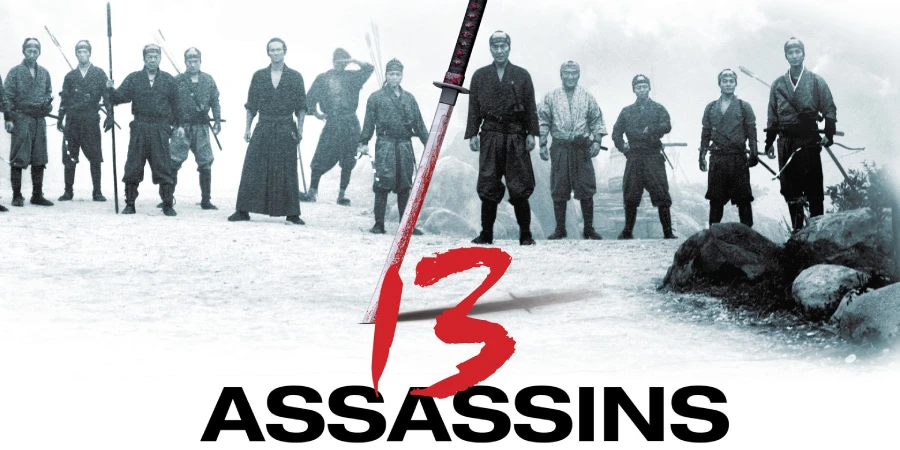
13 Assassins is a remake, of Eiichi Kudo’s original “Jûsan-nin no shikaku”, by director Takeshi Miike (Ichi the Killer). The tale is based in historic fact, although the official version of events differs somewhat from the film. The age is just 23 years before the end of the Shogun era. Edo is the capital.
The ancient warrior class of Samurai have their hard won peace threatened by the possibility that the degenerate and sadistic Lord Naritsugu Matsudaira (Goro Inagaki) will one day become the next Shogun. Some Samurai know this would be disastrous as the Lord Naritsugu is a raving psychopath, who finds excitement in other’s suffering and believes war will not only bring excitement to his life, but be good for Japan.
So, the plan is to convince the best Samurai still living to accept the deadly deed, and kill Lord Nartisugu.
That Samurai is Shinzaemon Shimada (Koji Yakusho) who has retired from his way of life, to quietly fish. Shinzaemon is summoned by the top Shogun official Sir Doi (Mikijiro Hira), who asks Shinzaemon to gather together the best Samurai fighters he knows, but together they can only find eleven others, some of whom must prove they have sufficient skills to be of use and not a hindrance.
So some of these eleven Samurai are put through training to prove they are up to the task.
Along the way, to ambushing the evil Lord, after taking care of a large group of “thugs” sent by surprise to kill them, they discover a young country yokel who lives by his wits in the forest, but when they find him, he is suspended 10 metres above the forest floor in a net trap. They cut him down and agree to use him as a guide. The yokel Koyata (Yusuke Iseya) seems silly and preoccupied with finding things to eat, and he has a grduge against snobby Samurai, but he later proves his mettle, when they decide he will be the 13th member of their assassin group.
The Koyata character is the typical comic relief, to be found in Japanese stories, and more often in the stage shows of Kabuki.
In general the initial introductory subtitles flashed by so fast I worried that it would continue, at the same rate, throughout the film. Luckily it didn’t. The dialogue was sparse enough to get into the interaction of characters, albeit they were briefly introduced and then, oddly, apart from the ultimate bad guy Lord, the Samurai blended in with the background, in the mire, mud and blood, so one tended to lose sight of who was doing what.
The DOP (Nobuyasu Kita) and director Miike obviously strove for an ancient look, an almost Daguerreotype imagery; dark and shadowy, with muted tones and often half lit faces, which added that feeling of age and made one concentrate on their facial expressions. Chiaroscuro it may have been, in a painterly sense, but overall I found the lighting levels to be too low, too much detail is missed, and even though it gave the film an aged look and certainly some atmosphere, I felt it was a tone too far down the light meter scale.
However, through the gloom, some stylised posed scenes, with the characters barely moving, except for the eyes, mouth and maybe an eyebrow, served to intensify the predicament at hand.
Then there were the scenes of barbarism, which were deftly handled, I will not elaborate, but, some may not want to watch those scenes. One in particular, where the tortured woman demands justice that the Samurai kill all her persecutors, I shall remember that scene for quite some time! It is like a moment from an epic horror, as was the family scene where the Lord dipenses his unique and twisted type of bloodlust justice.
The final fight scenes, seemingly relentless, with terrible odds, 13 against 200, starts out well, but then realism is interfered with, by the huge and complicated construction work done overnight in a township, which serves as a trap for the evil Lord.
Putting my quibbling aside, the film was not as blood thirsty as I thought it would be, but, there is a lot of violence and lots of incredibly well choreographed sword fighting scenes, quite remarkable, and it left me wondering how many accidents they had on set?
This film certainly has some technical faults and some stylised moments in the fighting, that are quaint and typical of such Japanese period dramas, however, if you grew up on watching the TV show Shintaro, which I did myself, these odd moments of pause midst fighting, will make many old Shintaro fans smile.
However, this film deserves to be seen and I should like to watch it again, as so much is happening in it, you can’t take it all in, on one viewing.
Heavy gore fans may be a little disappointed, saving for a couple of very ugly scenes.
For more movies like 13 Assassins 2010 visit Hurawatch.
Also watch: