
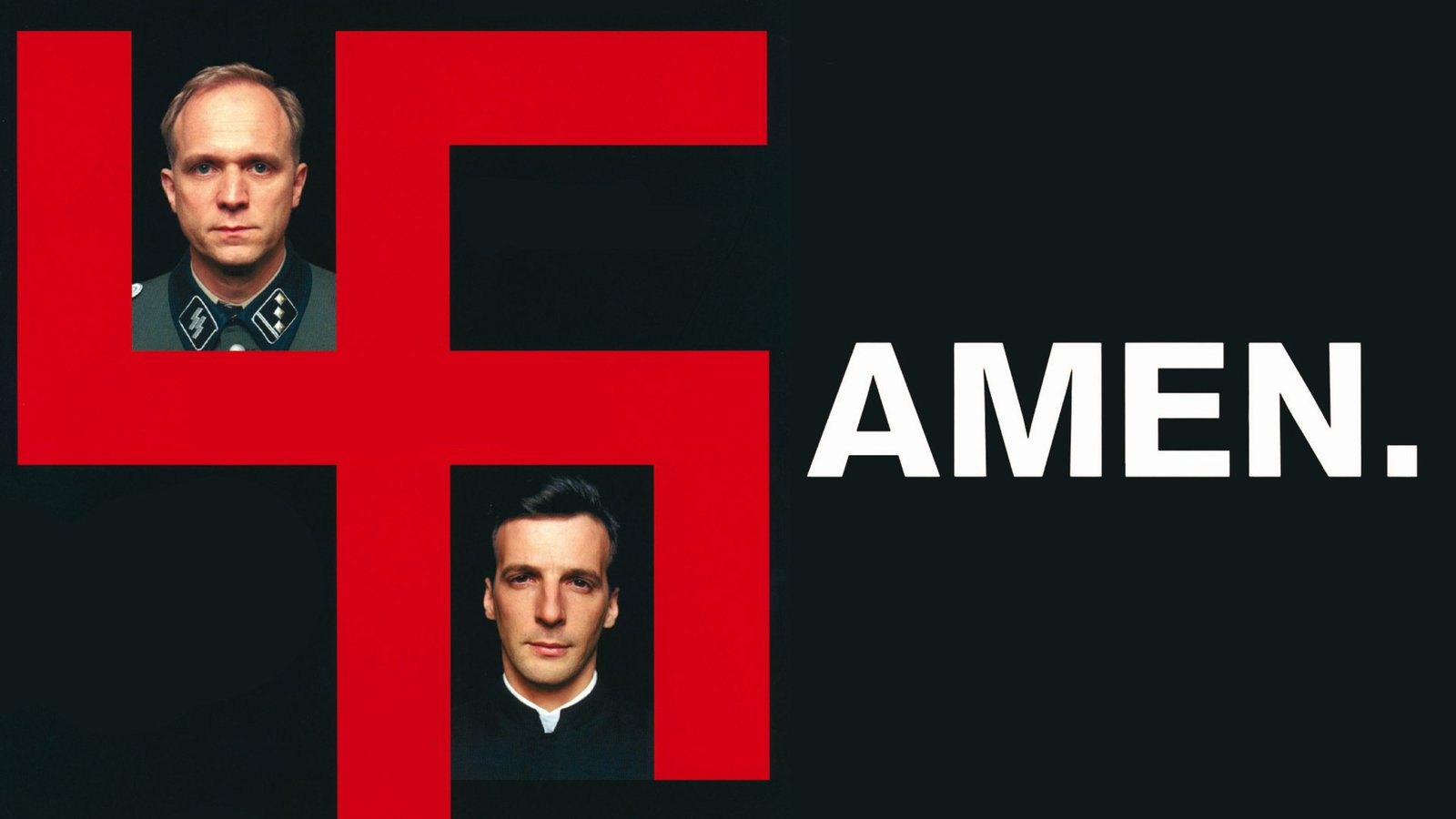
In 1999, a well regarded Catholic journalist published Hitler’s Pope The Secret History of Pius XII, in which he argued that the titular pontiff, who reigned from 1939 to 1958, had not only failed to speak out against Hitler but had actively ignored evidence of the Holocaust and cut self-serving deals with Berlin. The reaction of many Catholics around the world was, not surprisingly, vituperative and self righteous anger. In 2002, when firebrand provocateur Costa Gavras (Missing, Z) made the film Amen., based on a 1960s play which dealt with the same subject, it should have provoked a similar tidal wave of denial and fury – if only it had been a better movie.
Costa-Gavras’s flimsy script presents a pair of opposites who must try and bring news of the Holocaust to the Pope, in order that he may publicly denounce it and rally Catholics, in Germany and around the world, against Hitler. Ulrich Tukur plays Kurt Gerstein, an SS officer in charge of delousing troops and decontaminating water.
When he is assigned a new duty of overseeing the use of Zyklon B gas in concentration camps, the deeply Christian Gerstein who until then had hidden behind the belief that he was only serving his country is horrified and desperately tries to find somebody to hear his story. German after German turns a deaf ear to him, until he finds Riccardo Fontana (Mathieu Kassovitz), an idealistic Jesuit working in the Vatican’s Berlin office. Confronted with the reality of genocide, Fontana makes for the Vatican, where he hopes to use his father’s connections to win an audience with Pope Pius XII (Marcel Iures).
The most incredible aspect of this story is that, of the two main characters, Gerstein seemingly more unbelievable as an SS officer with a conscience was the real person (Fontana’s character is a composite of many priests who fought the Vatican’s silence during the war). After failing to get anybody to listen to him during the war, Gerstein gave elaborate testimony about the concentration camps towards the end, and died in a French prison in 1945 (whether it was suicide or murder by other imprisoned Nazis is unknown).
But somehow Costa-Gavras scuttles everything he has going for him by subjecting the audience to a script that defines meandering and gives Gerstein and Fontana little to do but proclaim their message. Amen. gives us so little knowledge about either of these men that their transformation into single minded avengers is played without resonance.
Even the confrontations between Fontana and the skeptical Vatican bureaucracy (who, like most of the world, didn’t want to believe the “rumors” of the Holocaust and, like many Catholics, were secretly hoping that Hitler would defeat the atheistic Soviets) have no sting to them, they’re stillborn after Fontana is rebuffed. The only affecting scenes have no people in them it’s the repeated shots of trains rumbling across the screen, first with doors closed and presumably full of victims, then later going in the opposite direction, doors gaping open, empty and ready for more.
Amen. is so clueless as a film that it even wastes an eye catching thespian like Marcel Iures (whose bored, dissolute Nazi commandant was the high point of Hart’s War, and who could have played this distant, calculating pope without blinking an eye) by giving him next to no dialogue. Tukur is affecting as Gerstein, his round, likeable face and warm eyes are reminiscent of Will Patton on a good day, and Kassovitz fairly smolders with intensity, but they can’t save the unsaveable.
This is a story that demands perfection, and deserves a film constructed of damning evidence stacked up scene by scene, then set ablaze by a firebomb rage. But the actual result is a sputtering, wet firecracker a film that hopes to substitute occasional cheap ironies and flat speechmaking for truly heartfelt moral indignation.
For more movies like Amen (2002) visit Hurawatch.
Also watch: