
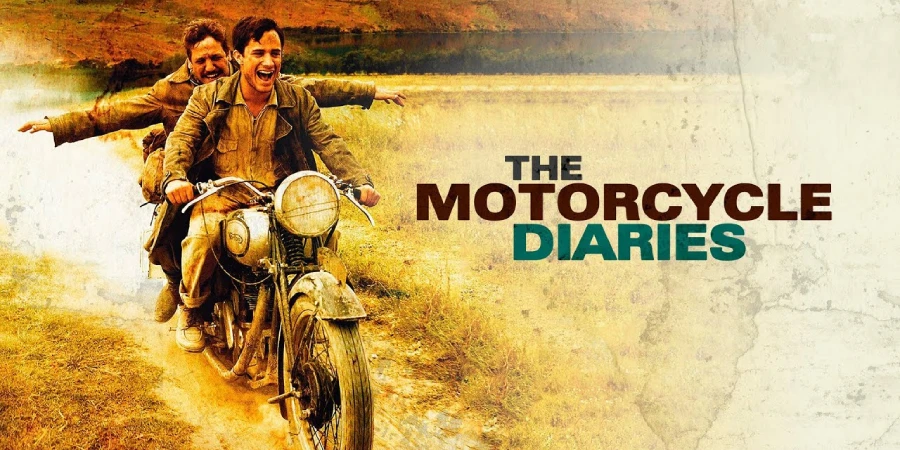
Set in 1952, this film begins in Argentina, with two great friends embarking upon a long journey, on a Norton 500 motorbike, of dubious mechanical condition. Their intention is to taste life before they settle down to finish their respective medical degrees. They intend to traverse the great continent of South America. We follow them lurching, skidding, falling and rolling over into ditches and dirt tracks. Then we discover Ernesto, called Fuser by his friend Alberto, has a puppy in his bag, for his sweetheart.
They visit her family mansion, they flirt, and farewell with promises of her waiting for Ernesto’s return. Ernesto (played by Gael Garcia Bernal) and his hunkier Norton 500 loving pal, Alberto (played by Rodrigo de la Serna), then set off again into the wilds of South America.
We follow them as they battle the elements, mechanical breakdowns and financial desperation, with Ernesto refusing to use his girlfriend’s US$15-00, he is keeping to buy her an American swim suit.
I admit, I was not looking forward to the rest of the film, as following the action while reading the subtitles was a little tiresome at times, made especially so by the thought of a harmless road film, devoid of any belly laughs, or great insightful import, or in depth character development, combined to make me feel, what is the point?
However, I kept watching, as the backdrop to the boy’s antics, the incredible South American countryside and culture, was complimented by the handsome looks of our young heroes.
As the boy’s financial difficulties threaten their survival and friendship, we at last see some colourful characterization, as they con the local newspaper that they were great physicians, who had saved 3,000 souls from leprosy during their travels. They slowly make their way, the caring Ernesto helping others where he can, and Alberto trying to seduce every pretty female he meets, or at least gets them to buy the boys a beer and food.
This film is not pretending to be a Hollywood road movie, it moves at a steady pace more in harmony with its physical and social environment, which seems appropriate.
As they get deeper into Indian country, the mountainous regions of Peru, and the amazing Machu Picchu, Ernesto writes in his diary and in letters home to his mother, of all that he sees. What particularly arrests his attention, is the plight of the indigenous population, the Indians, and their association with the land, historically, spiritually and culturally, and how that is slowly being trampled upon by petty local tyrants, who dispossess them of their lands and often enslave them to work for a pittance in dangerous conditions. The Indians’ sense of community and cultural identity is being subsumed by their desperation to survive in the new world conditions of economic slavery.
As this film progresses, so does both the insight and emotional maturity of the two friends. They continue to meet and engage with the indigenous people, as they head towards their goal of reaching a leper colony to offer some assistance Ernesto is a student of medicine, Alberto is a medical doctor.
Along the way, we see the incomparable genius and beauty of the ancient Incan buildings, at Machu Picchu, in Peru. Hauntingly beautiful black and white tableaux of the Indian people appear as interludes and reflections.
The Spanish had destroyed their mighty Inca Empire, and now the descendants were left to live in the dusty dreadful town of Lima. This is 1952, this is a time when social evolution and revolution is nearing its day in the sun for some, and we are witness to one of its pivotal players, Ernesto, as he slowly gathers the insights he needs to direct his future life’s course.
When they reach the leper colony in San Pablo, the two young men immediately insist on waving the separatist and discriminatory olden day rules, where one always wore gloves, as insisted upon by the old Mother Superior, head of the nuns nursing the lepers.
In the three short weeks they are there, Ernesto brings humour, play, humanity and affection to a small world of stigmatized people isolated and shunned, abandoned by their families and fired from their jobs.
On the eve of the two friend’s leave of the colony, the medical community gives Ernesto a parting gift, a raft they built so the two could reach their final destination, and it is then Ernesto gives his speech of thanks;
“The division of America into illusory nations is a complete fiction. We are one mestizo race from Mexico to the Magellan Straits. And so, in our attempts to free ourselves from narrow minded provincialism, I propose a toast to Peru, and to a united America.”
The nuns and doctors all greet these astonishing words with smiles and then applause, all recognized his words held great weight.
This film seemingly begins as a harmless road movie, but where it ends, is amazing.
Luckily, I had no idea who we were dealing with and what would be the eventual circumstances of our motorcycle buddies, eight years from parting, at the end of the film.
The photographic tableaux at the end made the impact for me all the greater. It is a film everyone should see. It gently infuses into you, and makes you ponder upon the direction we are currently headed, in our world of today. This film is a true story, of two amazing people, set in the fabulous landscape of South America. Watch it and be surprised.
For more movies like The Motorcycle Diaries (2004) visit Hurawatch.
Also watch: