
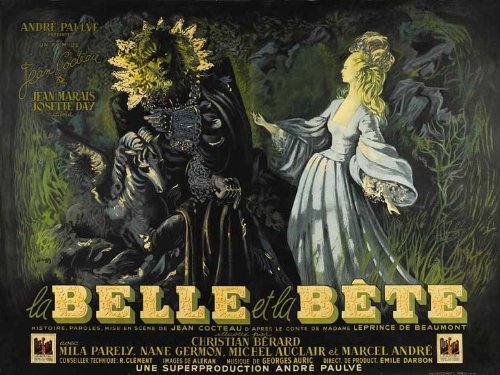
When Jean Cocteau began to direct Beauty and the Beast (La Belle et la bête) in 1946, he was known primarily as a poet and a painter. After the film was released he instantly became one of the finest French directors of his era. As it stands today Beauty and the Beast is still one of the best French films ever made.
The basic story, by Jeanne-Marie Leprince de Beaumont, is well known to most of us A merchant (Marcel André) steals a rose from an estate owned by a beastly looking character. The Beast (Jean Marais) tells the merchant that he will spare his life if one of his daughters can stand in for him. The merchant reluctantly offers up his daughter Belle (Josette Day). She enters the Beast’s world completely afraid of him but in time she grows to pity and then understand him. Ultimately she falls in love with him for his inner beauty rather than his external ugliness. And just about the time she accepts him for his ugly nature, he turns into a prince.
It’s a fairy tale indeed! But the theme of looking both fear and death in the face and transforming it into something positive comes through pretty clearly. Especially in the end when the film turns all the longings and desires of both Belle and the Beast into reality.
The film has a slow start developing the family that surrounds Belle. We see that her sisters are the evil greedy types who are jealous of Belle’s good looks. And we know that they will get their comeuppance in good time.
But once Belle enters the Beast’s castle, the film takes on a magical form. One of the main reasons is because of the sheer magnificent look of the film. With the help of fine cinematographer Henri Alekan, who gives the film brilliant images that evoke everything from a Vermeer like quality to a luminous black & white look, and assistant director Rene Clement, who was a well known director himself, Cocteau creates one of the most enchanting films of all time.
Cocteau was attempting to approximate the spirit of the tale by conjuring cinematic tricks. But he wasn’t interested in special effects that you add in the editing room. He wanted to use tricks that could be caught on camera through superimposition, slow motion, and running the film backwards for dreamlike effect.
He also with the great production help of Christian Bérard, costume design by Marcel Escoffier, and set design by Rene Moulaert created an amazing set, which included candle chandeliers held by arms that protrude from the walls and fireplaces with living face statues that have eyes that follow the occupants around.
For more movies like Beauty and the Beast (1946) visit Hurawatch.
Also watch: