
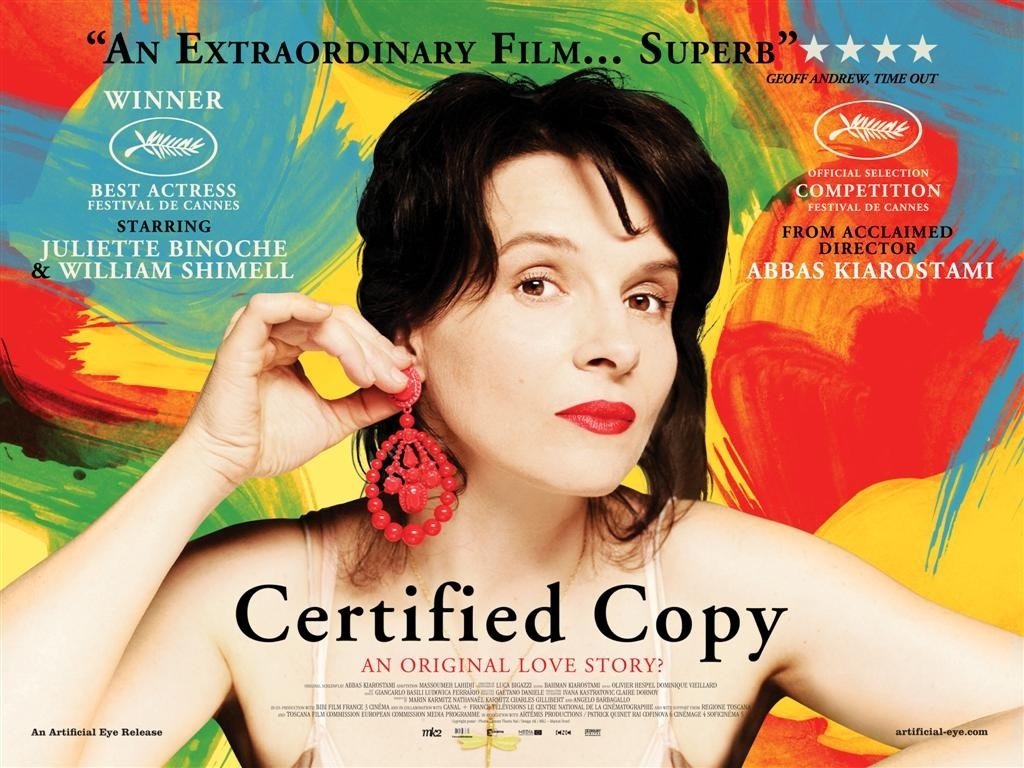
Certified Copy has garnered a lot of attention internationally since its introduction at Cannes back in May. It thus lands in Australia with plenty of critical baggage hanging from its rather slight frame, and the first thing to say is that the film perhaps suffers as a result of that hype.
The truth is that this is an intriguing but flawed piece of filmmaking, full of fascinating subtext but hampered by a difficult narrative top line and a couple of characters who are at times barely sympathetic.
Acclaimed Iranian director Abbas Kiarostami and French star Juliette Binoche working together on a film is big news, but it’s been the casting of English baritone William Shimell opposite Binoche that has arguably attracted the most attention, and in some quarters the most criticism. Shimell had never acted in a film before and taking on a role such as that in Certified Copy can’t have been easy. Some critics have accused Kiarostami of stunt casting, and it’s a hard point to argue, but Shimell does an admirable job, and any deficiencies in his performance should more readily be laid at the feet of the film itself.
The film is set in the Tuscan countryside, where a woman (Binoche’s character, never named) runs a small art gallery. In the film’s opening scenes she attends a lecture given by a visiting English art critic, James Miller (Shimell). Miller has recently written a book called ‘Certified Copy’, in which he argues that reproduced or copied artwork can in some circumstances be as emotionally authentic as the original.
On his final day in the area, the woman invites Miller on a trip to a nearby town. Along the way they talk about art and life, but what seems a pleasant day takes a strange turn when a barista mistakes them for husband and wife. Or does she? Because Miller and the woman begin to act as if they are husband and wife. They play their parts to this game so convincingly that as an audience you end up not being totally sure. The parallels with Miller’s specialty are obvious, and so the film works through its themes in a fairly open fashion.
Unfortunately, Certified Copy seems a prisoner to its ideas. Binoche and Shimell’s characters are little more than ideas themselves, cut carefully to transmit writer-director Kiarostami’s vision, but never quite ringing true as real, sympathetic people. Miller in particular comes across as an ass, self important and unwilling to communicate. There’s an argument that in a more capable actor’s hands, the character would have been fleshed out properly, but the fusty art critic actually benefits immensely from Shimell’s easy charm. Binoche is at times mesmerising and seems totally onboard with Kiarostami, but her take on the woman sometimes has all the appeal of somebody with a full-blown personality disorder.
Because everything is so focussed on these two central characters, there’s little relief from their seemingly bitter gaming, and it can make Certified Copy a hard slog. There are a lot of great ideas contained within the film, and as a philosophical piece it does get you thinking, but it engages with the audience at a passive level and you never really care about what’s going on onscreen. In that sense it’s frustrating because you can see what Kiarostami was aiming for, but Certified Copy ultimately falls a little short of its own ambitious goals.
I say:
An admirable experiment but ultimately an unsuccessful one. The film has tended to divide critics, however, and for a more positive take on Certified Copy I’d recommend checking out Dave O’Connell’s review over at Screenfanatic.
See it for:
Regardless of its faults, there’s no denying that the performers and the countryside are very appealing. The film also benefits from some fantastic photography, courtesy of Luca Bigazzi.
For more movies like Certified Copy (2010) visit Hurawatch.
Also watch: