
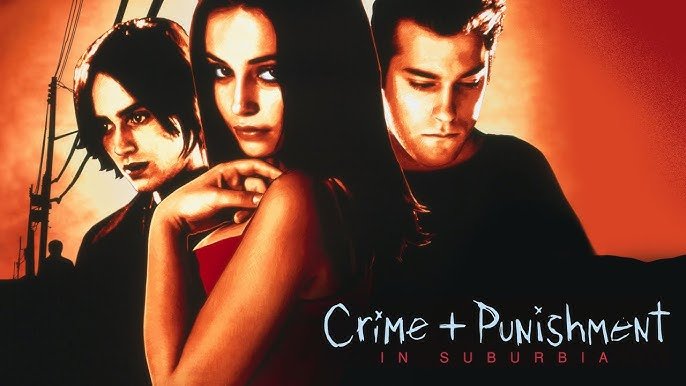
If you’re seeking enlightenment on what you think would be a modern reverberation on the timeless Fyodor Dostoyevsky masterpiece, don’t be misled by Crime + Punishment in Suburbia. While the film opens with a quotation from Crime and Punishment, which, I suppose, is intended to lead us to a new interpretation of the book, that’s the only (tenuous) connection.
In the novel, the protagonist, Raskolnikov, rebels against the morality imposed on him by a society and kills an innocent woman. He later discovers that the worst punishment for the murder was the one his guilty conscience made him to endure. And perhaps, if you concentrate hard enough, the suffering Raskolnikov could conceivably parallel that of a pudgy adolescent Roseanne (Monica Keena, ex of Dawson’s Creek), one of the main characters in the movie.
Completed before American Beauty, this artificial little movie resembles it in every way possible, mainly because it examines the very same set of stereotypes about malfunctioning wealthy suburbanites. Vincent (Vincent Kartheiser), a sallow loner, follows Roseanne everywhere with his camera. Given the privilege to provide voice over for most of the film, we hope that he is the voice of wisdom, or at least revelation in the story. Far from it: His philosophy is one of a self-possessed New Age spiritual guru who is convinced he can save Roseanne from hell she is living in. What Ricky was able to see with his lens in American Beauty revealed the hidden layers of human behavior. Vincent, by comparison, as well as the whole ensemble of characters in Crime + Punishment, goes through the plot’s twists and turns without a single coherent thought in his head.
The genre of the film is familiar using the suburbs as an emotional terrain where the sense of unwholesomeness surrounds the surfaces of people’s life and threatens their seemingly secure shelters. In Roseanne’s family, we have a complete set of obvious characters: a psychopathic stepfather (Michael Ironside) with a face of a bulldog and a penchant for heavy drinking, a frustrated and suffering mother (Ellen Barkin), and a vacuous, popular little girl who dates a football player (James DeBello). What follows is supposed to be a tragedy of revelations, in which a gloomy loner Vincent will help Roseanne rediscover herself and alter her perception of the world forever. Supposed to be.
What attracted me the most in American Beauty was how punchy and derisive yet humane the film was. It carried a deep loss for the human connection, a charge that gave the film its integrity, the weight of reality. The humorless Crime + Punishment substitutes this depth with a slow motion camera, elaborate soundtrack, suggestive visual themes, and a stupid voice over.
To completely befuddle us, the film switches from Vincent’s voice over to Roseanne’s. In a chillingly dispassionate voice, she narrates from jail and says how much she enjoys her non-existence. “I killed somebody. I was sorry. It changed nothing.” When freed, she follows Vincent as her savior and marvels, “What a strange path it took to find my heart.” But first, you have had to believe that she even has one.
For more movies like Crime + Punishment in Suburbia (2000) visit Hurawatch.
Also watch: