

There’s an iconic photo taken on the shooting of “Apocalypse Now” of director Francis Ford Coppola holding a pistol to his head, his eyes locked with the camera in a bestial, glazed look. That pose may well have been a joke, but it’s served to encapsulate the passion and terror behind “Apocalypse Now” a director takes cast and crew into the jungle, in the hopes of capturing the descent into madness depicted in Joseph Conrad’s Heart of Darkness.
Adapting Heart of Darkness is the white whale of filmmaking; it’s been attempted by many directors, such as Orson Welles, and Coppola’s vision is the one most often remembered, as it was a powerful, crazed masterpiece.
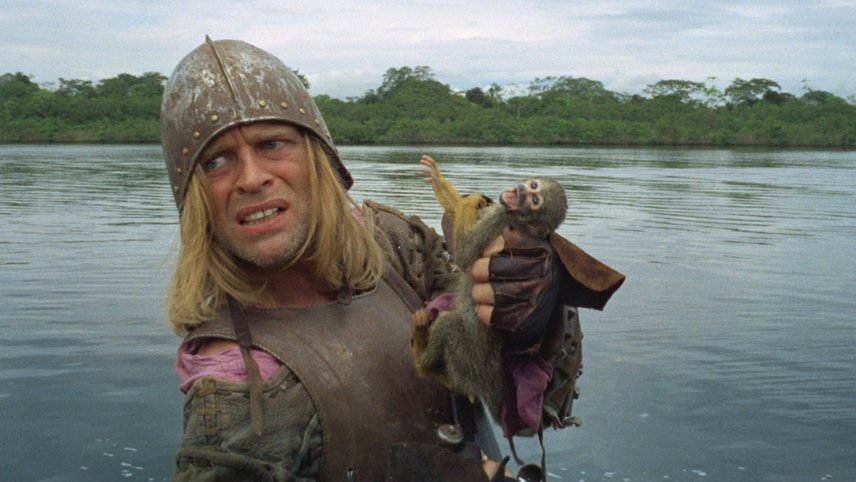
Coppola’s vision was heavily influenced by another film, one by Werner Herzog, called “Aguirre, Wrath of God”, which depicts the struggle of a group of Spanish conquistadors to reach the legendary city, El Dorado.
From the opening moments of “Aguirre, Wrath of God”, the viewer understands that this is going to be heavy cinema; we are treated to a breathtaking jungle gorge, mist creeping over the vines, only to notice a line of people, tiny like ants, making their way down a steep, rocky path. Some of them are dressed in Spanish armour, some are carrying livestock. The camera pulls back to show us the line continuing down the gorge and coming up the other side, hundreds of people, struggling and making their way up this mountain.
After that, the film proceeds to get dark and haunted. There is no optimism, save that for the search of the golden city, and you can’t help ask, why?
The soldier, Aguirre, is played by Herzog’s favourite actor, Klaus Kinski, a barbarous man in real life, and a fearsomely talented actor. They worked together on five films, which would cement Kinski as one of the best European actors in cinema, but it’s here, in “Aguirre”, that we see Herzog’s fascination.
Kinski’s face is that of a savage heavy brow, cruel, steely eyes and a sneering lip, pulled back into a grimace. As the traitorous Aguirre, Kinski is magnificent, effortlessly ordering people to be shot, screaming at his men, beating the native slaves they have with them.
Herzog’s film is an examination of the regression to brutality that civilized men can fall into, spurred by greed and the desire for fame, but the Heart of Darkness almost consumed him, as it did Coppola. Kinski was unbearable to work with, the rivers were angry and dangerous, and the jungle always threatened to hold them back, but such compelling images captured on screen who else would have the drive to make this film?
“Aguirre, Wrath of God” is not an adaptation of Heart of Darkness, but it captures the same sense of dread, where, even in 1972, a filmmaker could be consumed and eaten by nature. A less exploitative construction than “Cannibal Holocaust”, Herzog’s film looks deep into Kinski’s eyes, suggesting that Aguirre never fell into madness, but that it was always there, waiting dormant, ready to hatch and terrorize.
This is cinema, glorious cinema, fraught with treacherous cliffs and violent crashing rapids.
I say: I loved every second of this, and I’m looking forward to watching the rest of the movies in this fantastic collection.
See it for: It was hard to look away from one of the noblewomen brought on the expedition, played by notable Mexican actress, Helena Rojo. She captures a strong silent grace, speaking up when she has to – but up against a madman…
To watch more movies like Aguirre, the Wrath of God 1972 visit hurawatch
Also watch: