
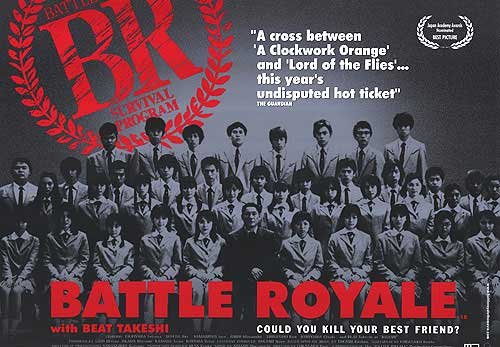
Consider a parallel world at the dawn of the new millennium. Unemployment is rampant, national morale is low and the country’s youth are unruly and dangerous. The government’s solution: Banish one school class per year to a deserted island and force them to kill each other. Three days, no rules, one winner.
If you’ve never heard of this twisted action thriller a film that appears to have strong potential for box-office success it’s simply due to American sensitivities. Since its release in 2000, the Japanese Battle Royale has been an acclaimed cult hit in its native country but for obvious reasons of content, chances for American distribution hover somewhere between slim and none.
The Japanese Academy nominated this cautionary tale for seven awards, including Best Picture. While Battle Royale doesn’t really sustain a consistent gravity (or tone) worthy of exalted accolades, the film is still a sinister adventure that could now be seen intended or not as a dark criticism of the limits pushed by current American “reality” TV ridiculousness.
Based on a controversial Japanese novel by Koshun Takami, Battle Royale opens with a spooky, foreboding introduction. Hordes of reporters swarm around a military vehicle said to be carrying the most recent winner of the brutal survival game, a member of a randomly selected 4th grade class. The champion is a small girl with a bloodied face, clutching an old teddy bear. She smiles broadly.
Fast forward to the next class (teenagers this time) and about 110 minutes of death. Popular Japanese actor/director Takeshi Kitano (appearing here as Beat Takeshi) stars as the core of the game’s operation, a vengeful teacher with icy steel running through his veins. Takeshi’s character is a sadistic lunatic pushed too far by today’s kids a guy who thinks nothing of killing the children himself to prove a point.
As twisted as it sounds, killing off 41 teens takes a great deal of creativity and an innate sense of pacing in order to avoid, well, cinematic boredom. Director Kinji Fukasaku (along with screenwriter/son Kenta) makes a valiant attempt, providing a barrage of slayings, suicides, and accidents that slowly whittle the numbers down to a select few. Each death is documented on-screen like a baseball box score, providing the player’s number and name, along with the number of students left. It’s a cold, effective touch, a detached way to chronicle this government-run Lord of the Flies, a sort of forced version of Darwinism.
As the plot progresses, the Fukasakus take the time to flesh out characters to varying degrees, making clear which students will last toward the final showdown. Even within the tight parameters and seemingly predictable mini storylines, the filmmakers are still able to buck expectation and convention down to the last.
The problem is that Battle Royale delivers a mixed message. The early scenes especially a howl of a “class orientation” led by Takeshi are a morbid mix of hardened violence and dark comedy. As the film’s body count climbs during the competition, there are some insightful and almost touching takes on the general problems of being a teenager. But the Fukasakus wrap up with a gratuitous, tacked on change of pace that attempts to deliver a message of empowerment and solidarity. It ends the bang-bang storytelling with a bit of a thud.
That inconsistent tone eventually takes away from the film’s overall success. Running the gamut of emotions simply doesn’t work for a social commentary as dark as this one even if the constant violence tends to get diluted through repetition (a powerful comment itself), leading some viewers to need more from the movie.
For more movies like Battle Royale (2000) visit Hurawatch.
Also watch: