
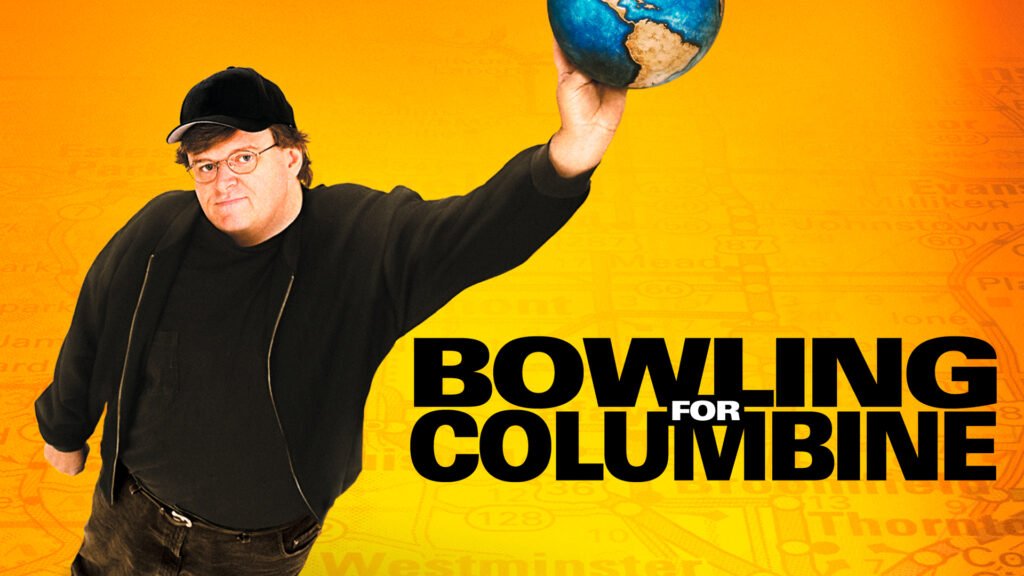
No one will ever accuse documentary filmmaker Michael Moore of being even-handed. In his funny, somber, anti-corporate debut, Roger & Me (1989), and his two, eat the rich style television series, Moore establishes his stance (the humorous left) and then makes his case, swaying all subject matter toward his ideals, and making the opposition look like idiots. The beauty of this is that Michael Moore doesn’t have to be fair He’s not a network journalist he’s a gonzo moviemaker, utilizing gentle, almost lovable, guerilla tactics in an effort to make a statement and entertain. And with Bowling for Columbine, Moore does this with more skill and hard edged comedic tone than anyone else today.
Moore’s disgust for the corporate machine so proudly displayed in Roger & Me rears its head again in Bowling for Columbine, but it’s just one piece of an enormously ambitious puzzle that Moore attempts to solve: Why is America such a remarkably gun-violent society?
If you think you have a pat answer, be you an anti-weapon Democrat or a gun-totin’ Republican, think again. Moore examines, often with tongue in cheek and index finger scratching head, video games, TV, movies, the media, music, parental pressure, poverty, the government, racism, the culture of fear, and more. The answer: There really are no answers.
But Moore makes a simple point as he takes us to visit the Michigan Militia, Terry Nichols’s brother, or Littleton, Colorado: There are many things wrong with American society and how it views violence. Sure, it’s easy for a liberal like Moore to say this, but there are two things worth remembering: First, he is exceedingly thorough in support of his arguments; and second, he is a card-carrying member of the NRA and, as a teen, was a champion marksman. In fact, his NRA membership helps him get face time with Charlton Heston (in Heston’s pool house!) for this film.
As a filmmaker, Moore is still an immensely effective propagandist, but he has also matured. He has a greater respect for the gravity of his subject matter, has learned to use shock value to his advantage, and is even slightly more willing to listen to his “opponents.” Most importantly, Moore, with help from editor Kurt Engfehr, has become an exceptional composer of images and a master of timing. If you doubt his skills, witness his use of news clips containing horrifying gun murders, or security camera footage from the massacre at Columbine High School.
From a purely editorial standpoint, Moore is a true manipulator, often a relentless one. The guy could probably translate that skill and his “aw shucks” demeanor into a career in politics (if he shaved more often and wiped the schmutz off his shirt). A politician should know his history, and be able to capture minds and speak to people. Moore successfully does all of the above in Bowling for Columbine, and with the help of two young men that suffered injuries in the Columbine shooting, he even enters the corporate world and affects major change.
Moore’s combination of horror and levity is sharp, uncomfortable, and evocative. Sometimes it is delicate, mixing it up in the background often it is a sledgehammer to the brain. It can cause an inner stirring in many viewers, a brewing range of emotions resulting in hearty laughs or the occasional shout at the screen. Whether or not you appreciate Michael Moore’s politics or delivery, I can’t think of too many films this year that get the heart pumping like that.
For more movies like Bowling for Columbine (2002) visit Hurawatch.
Also watch: