
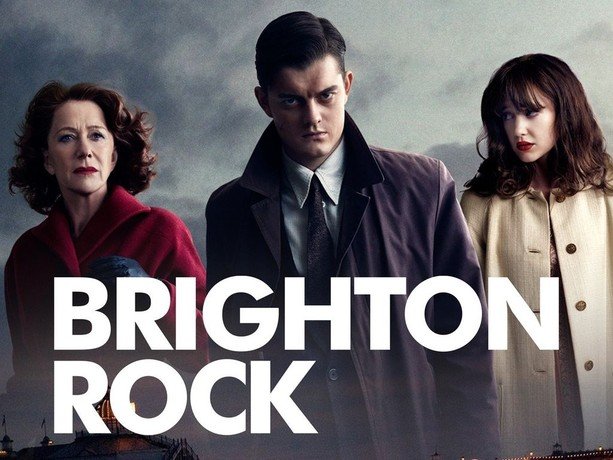
This is a tale of sinister motives and the posturing of a ruthless young punk, Pinkie Brown (Sam Riley), who fancies himself ascending the food chain in the dog eat dog underworld of Brighton. Greene’s version of this place was teaming with the seedy excrescence of a expanding underbelly grim faced, cold hearted bit players concealing knives behind white knuckled, recriminatory gesticulating. In evocative prose Greene entrapped his readers in this life of base motivations writ small beyond the seaside tranquillity and carnivalesque veneer.
When Pinkie’s low-rent gang take out a troublesome fringe-dweller, Fred (Sean Harris), he must act to conceal any evidence that links him to the deceased. A snap taken by a boardwalk photographer of Fred, one of Pinkie’s pursuing offsiders, Spicer (Phil Davis), and a young girl, Rose (Andrea Riseborough), is foremost in his mind. To uncover any knowledge Rose possesses he unsubtly inveigles himself into her favours.
Rose is a pathetically innocent, unworldly creature; a simple girl but, meaningfully, with “a memory for faces”. How far will Pinkie go to keep the truth from spilling into the light? The meddling Ida Arnold (Helen Mirren), Rose’s employer, may prove to be the most obstinate barrier set in his path.
None of these characterisations measure up to the formidable original creations. It may be unfair, of course, to judge them against in that context, but it’s hard to avoid longing for a Rose with a more acutely rendered sense of fragility, of doe eyed innocence emphasised with painful, ultimately life threatening, naivety.
Regality and credentials aside, Mirren is badly miscast as Ida; she neither possesses the imposing physicality of Greene’s creation or the irreverent moral certitude that compels her to stick her nose into everyone else’s business in a single-minded quest to save Rose from Pinkie, herself and damnation. Mirren’s Ida is quite literally out of proportion to Greene’s conception of her; she’s also far too respectable and held back from the narrative at junctures that are crucial to the novel’s uncomfortably alluring spirit.
Riley makes a very decent fist of bringing this delusional, misanthropic upstart to life but he’s fighting a losing battle from the outset, not to mention memories of Richard Attenborough’s brilliant turn in Boulting’s film. Pinkie is one of literature’s most fascinating villians, a young man contorted with contradictions framed within his Catholic guilt, he seethes at the wrongness of the world but feels no compunction in doling out violent measures that elevate his rise through the ranks of cellar dwellers beneath Brighton’s boardwalks.
The union of Rose and Pinkie is a twisted, poisonous one, a means to an end for him “You’re good and I’m bad, we’re made for each other” and a fateful entwining of “Roman” perspectives in her adolescent imaginings. Though there are occasional digressions into the theological ramifications of lives, the heat has been drained from Greene’s text the result is a toned down film that, although satisfying on its own terms and technically impressive, has little reason for existing.
I say:
A decently handled but ultimately subservient adaptation of an imposing novel with all the sharp edges roughened out.
See it for:
The work of Riley and debuting director Joffe son of Roland who are both bound for much better things.
For more movies like Brighton Rock 2010 visit Hurawatch.
Also watch: