
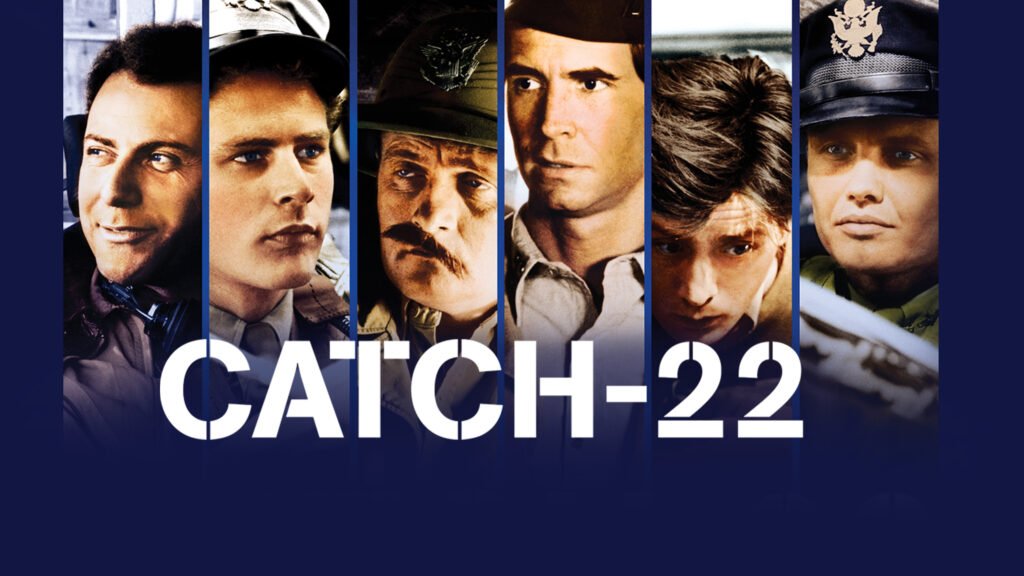
A wry and sarcastic (and thick as hell) book about the ridiculous duplicity of war? Sounds like a movie to me.
And so it did to Mike Nichols and Buck Henry, collaborators on The Graduate who conspired once again to make one of the greats of cinema. While Catch-22 has none of the cachet of other war movies (and we’ll get to that…), it’s by far one of the best out there, ranking with Platoon, Full Metal Jacket, and Apocalypse Now as one of the greats.
If you’ve never read Joseph Heller’s masterpiece of a novel, it’ll take some explaining to make Catch-22 make sense to you. As the title suggests or rather, as the title inspired a phrase that entered into the American lexicon our hero Yossarian (Alan Arkin) is trapped by a paradox. As a bombardier who’s ready to get out of the Mediterannean during WWII after doing his time, he implores the base doctor (Jack Gilford) to pronounce him insane so he can be shipped home. Since the rules state that insane men can’t fly combat missions, he’s home free, right? Unfortunately, there’s a catch: any man who tries to get out of combat must not be insane, and therefore he has to fly.
That’s just the beginning. Catch-22 spirals increasingly out of control, as over-the-top ridiculousness takes hold of the base and all of its crew. The terminus of this occurs when Milo Minderbinder (Jon Voight, perhaps the best part of the film) engineers the bombing of his base in order to get the Germans to buy warehouses full of chocolate-covered cotton that he has foolishly purchases (by trading the parachutes, morphine, and diesel engines lying around). Milo’s “syndicate” speaks to the arrogance and greed of government not only in wartime, but in the everyday world.
For more movies like Catch-22 (1970) visit Hurawatch.
Also watch: