
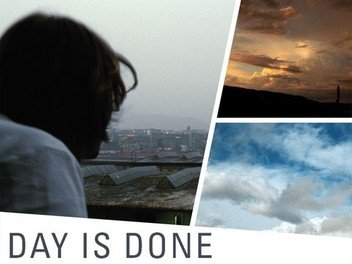
Day is Done features a novel narrative structure. Whilst pointing his camera outside his Zurich apartment, director Thomas Imbach has cobbled together a non-fictional ‘story’ entirely from messages left on his answering machine over the course of many years.
We hear the ramblings of his parents, relatives and other well-wishers, but most dominant is the voice of his ex-wife whose frustration at her dealings with him becomes the dominant theme. The pair shares a child and we get the impression that Imbach spent a lot of time either giving her the silent treatment or making the time spent with their son a chore to negotiate.
Though every shot is initiated and manipulated by Imbach we rarely feel his presence, a factor that renders him an aloof overseer. His voice is heard only a handful of times, and even then offers meagre insight into his own perspective. For him as ‘director’ of the film, creating a microcosm of life as objectively gleaned from his very subjective vantage point becomes paramount.
A stream of fascinating images oftentimes speeded up to impart a surreal flow-of-time effect regularly work their magic. But naturally, over the course of 110 minutes, duplication occurs, reducing segments of the film to redundancy. His preoccupations disrupt the flow, his motifs laboured, like a mail girl walking to and from work or a smokestack in the distance which receives prolonged treatments from his tireless lens.
Certainly Imbach deserves commendation for the originality of his concept even if the final product exposes it as a flawed one. Day is Done (2011) inspires enough awe-inspiring moments from an everyday horizon to make it a worthwhile, if not exceptional, cinematic journey.
For more movies like Day is Done 2011 visit Hurawatch.
Also watch: