
In many ways “Dogs in Space” is the archetypal 1980s Australian film. It’s full of confidence and clever innovation, but is hampered by a lacklustre script and a style of production dissonant with the material it covers.
Produced in 1986, it actually looks at Melbourne eight years earlier, when the city’s punk scene was at its most deliriously disgraceful. “Dogs in Space” follows the activities of a squalid Richmond share house overflowing with hippies, students, freaks and geeks. The nights are filled with drugs, parties and trips to the next ham-fisted gig.
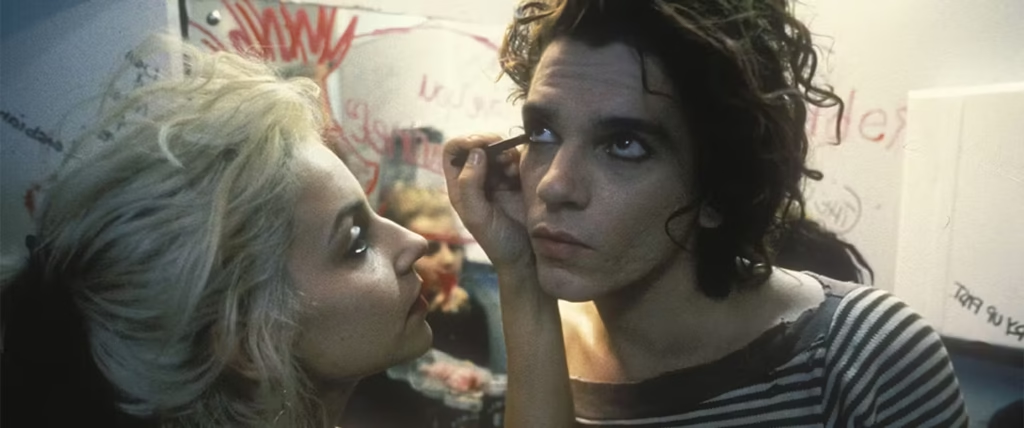
Central to the story is the relationship between Sam (played by Michael Hutchence and loosely based on the real punk musician, Sam Sejavka), lead singer of the band, Dogs in Space and his lover, Anna (Saskia Post). The two spend their time making love, taking drugs, drifting between gigs, fighting and making up again. But when the drugs become harder, the pressure begins to build on Sam and Anna’s unstable relationship and it threatens to spiral out of control permanently.
Writer/director Richard Lowenstein worked the “Dogs in Space” screenplay from his own experiences in and around the late 70s punk scene. Lowenstein actually lived with the real Sam Sejavka in the Richmond house used for the film when the two young men attended film school at Swinburne University.
Perhaps it was his close emotional proximity to the source material, but Lowenstein’s script is the biggest problem with “Dogs in Space.” He seems to really care about his characters, but never really gives the audience any reason to. Hutchence’s Sam is a self-indulgent, overly mannered, rude and reckless little shit, with little to recommend him as company for the entire film. It wouldn’t matter so much if there were some sort of logic to his and Anna’s relationship, but there’s not. Anna is sensible and sharp, and there’s little reason given as to why she’d be sucked in by a shallow prick such as Sam.
The film works a little better in simply conveying the world of the punks in the late 70s, but then the methods of production get in the way of the “Dogs in Space” being a convincing snapshot of the period. Andrew de Groot’s cinematography is technically brilliant, providing long continuous shots that flow through and around the terrace house, but it’s exhaustively overused, and the intended effect of placing the audience in the moment is soon lost. By halfway into the film, “Dogs in Space” feels less like a film and more like one extended, flashy video clip.
The young cast is certainly one of the shining points of the film. Michael Hutchence’s performance is surprisingly competent, his sometimes pallid delivery leavened by a rubbery physical performance that totally captures the real Sejavka of the time. But he’s arguably outshone by livewire Nique Needles as fellow band member, Tim, and most certainly blown away by the amazing Saskia Post, who lends Anna a gravitational pull that’s hard to resist.
It’s these performances that help smudge “Dogs in Space”’s overly slick façade and give the film a little bit of heart. Still, the whole piece never really ties together effectively, the film’s inability to tell a compelling story leaving it lacking in impact. “Dogs in Space” could certainly never be described as an ugly piece of cinema, but good looks only mean so much, particularly when dealing with a subject matter so aggressively anti-establishment as punk music.
For more movies like Dogs in Space (1986) visit Hurawatch.
Also watch: