
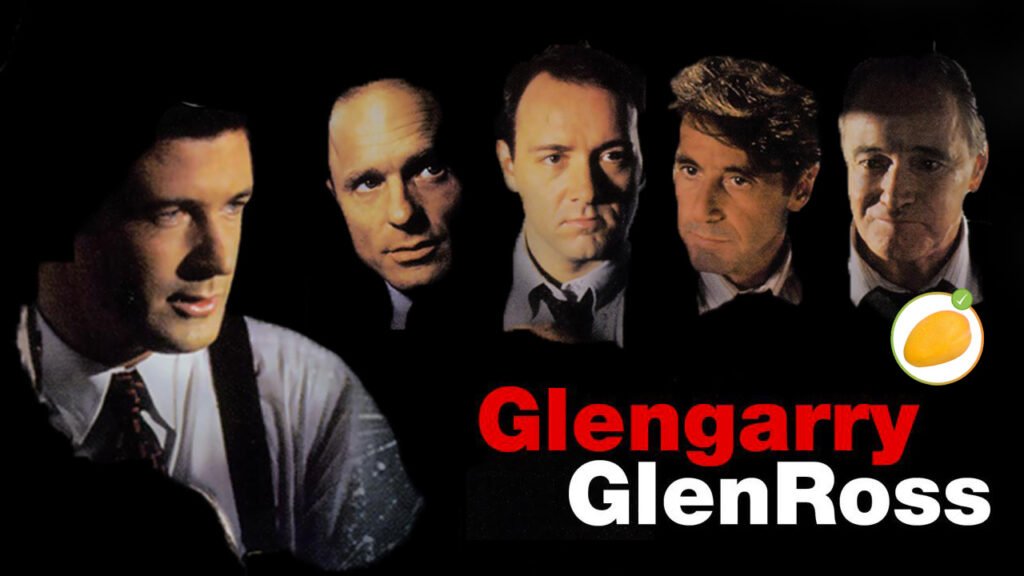
Since its original run as a Tony-winning play in the early 1980s, “Glengarry Glen Ross” has often been mentioned in the same breath as Arthur Miller’s “Death of a Salesman.” It’s a slightly reductive comparison, based purely on the fact that both works feature desperate peddlers running fast out of options.
“Glengarry Glen Ross” is less “Death of a Salesman” and more “Death of the Salesman,” a searing attack on dehumanising 1980s business practices as a batch of jaundiced real estate agents in a forgotten Manhattan office competes for the privilege of not getting fired.
The film version came into existence in 1992, David Mamet adapting his own work for screen for James Foley to direct. Despite its long gestation period, Glengary Glen Ross the movie retained much of the same structure as its progenitor, merely fiddling with locations and adding one particularly memorable, if non-vital, scene.
Jack Lemmon, Al Pacino, Alan Arkin, and Ed Harris play four Mitch & Murray real estate agents, given an ultimatum by their employer to either start selling or start walking. In an early scene, the salesmen are set upon by Blake (Alec Baldwin), the wolf from head office, who announces the running of a competition whoever sells the most real estate in the coming week wins a Cadillac, whoever comes second takes home a set of steak knives, and whoever comes third and forth clears out the contents of their desks.
Key to the sales efforts are “leads,” often hazy expressions of interest collected from put upon supermarket shoppers, and the quality of those offered to the agents for the competition are particularly bad. Each agent gets three, but whoever survives the weeklong competition will also gain access to the highly sought after ‘Glengarry’ leads, solid expressions of interest in prime real estate that are virtually money in the bank.
So, the agents are caught in an ugly catch-22 to get the good leads they need to sell the bum leads, but to make a sale they need access to the good leads. Each of the men approach the dilemma differently: George (Arkin) and Dave (Harris) rail at their seeming impotence Shelly ‘The Machine’ Levene (Lemmon), former office hero, pleads and deals for better leads than the worthless ones he’s been given; and office superstar Ricky Roma (Pacino) seemingly welcomes the challenge, looking to use the competition to his advantage.
Mamet has divided the action into two halves. The first, other than Blake’s outrageous speech, is Shelly’s time in the spotlight, as the aging salesman realises that both customers and management are blocking every one of his undoubtedly smooth tricks. Shelly’s daughter is in hospital and the man’s desperate to raise money for her medical expenses.
It’s an unbelievable performance, a desperate, musty aura surrounding Lemon as he tears through Mamet’s juicy quips and bilious vitriol.
The second half of the film takes place the following day after an office robbery and theft of the Glengarry leads. This section belongs to Pacino’s Roma, and it’s a style of performance audiences have since come to expect from the powder keg player. Roma spends the entire film trying to brace Jonathan Pryce’s skittish buyer, and his poetic powers of persuasion are almost as gripping as Levene’s pilloried circumstances.
They are often astonishing performances from Lemmon and Pacino, and Arkin and Harris, as well as Kevin Spacey as the put-upon and reviled office manager back them up admirably.
It’s a shame then that the film doesn’t work so well as a whole. “Glengarry Glen Ross” is an excellent play, it’s claustrophobic atmosphere suiting the stage well. But for his screen adaptation, Mamet’s small batch of changes is perhaps more of a hindrance than a help.
Baldwin’s speech as Blake is gripping in isolation, an absolute tour de force, but there’s no late payoff for this brilliant early bluster. It sets the scene well, but it also continues on for too long, promising a more involving onscreen narrative than is finally delivered.
The film also fails to broaden the scope of the story for the big screen. Director James Foley supposedly wanted to the film to continue the suffocating atmosphere of the original material, but it’s perhaps no surprise that this just makes everything feel stagey. It dents the dramatic momentum and cripples the characters, who suddenly seem thinner than their original counterparts. Ultimately, you’re left with little care for their diabolical circumstances.
In the years since, Mamet’s screenwriting has become more skilled, and he’s now able to balance his often beautifully ethereal and rhythmic dialogue with solid character development, but “Glengarry Glen Ross” struggles to truly motivate its audience into caring about the onscreen goings-on.
Still, if you’re ever in the mood to watch a batch of actors given licence to go full throttle with their material, then this will do the trick. Lemmon in particular reigns absolutely supreme. His character’s personal desperation is perfectly contrasted against a professional tone so silken it could seemingly unbutton any wallet, and for that alone “Glengarry Glen Ross” is worth checking out.
For more movies like Glengarry Glen Ross (1992) visit Hurawatch.
Also watch: