
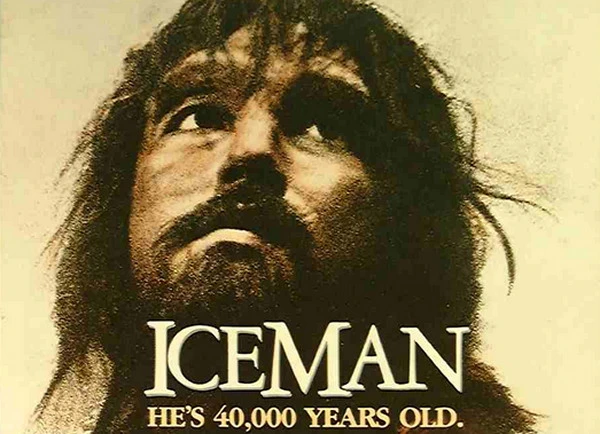
Fred Schepisi is one of the more considered filmmakers to make it into Hollywood’s top echelons. The Australian made his name through thoughtful renderings of religion (he studied to be a priest himself in his teens) and race, and once in America he would lend a delicate depth to material as potentially farcical as Roxanne.
But thawing a prehistoric man to life was perhaps always going to stretch even Schepisi’s considerable skill. If you know the filmmaker’s work, you’ll understand immediately that he was never going to play Iceman for horror schlock or cheap laughs (although there is much humour, both intentional and accidental, to be found here). But screenwriters Chip Proser and John Drimmer’s reflection on the state of mankind is too basic and hackneyed a vehicle for such grand questions, even is you suspect Schepisi gets the project closer to profundity than any other director ever could.
Iceman certainly looks good. Regular DOP Ian Baker was once again onboard with Schepisi, and the visual elements of the film are spectacular. Clearly influenced by The Thing from two years earlier, the initial scenes of the find deep in an arctic glacier field and a scientifically laborious thawing process are brilliantly captured, the film rattling along with breathtaking pace.
Scientists Brady (Lindsay Crouse) and Singe (David Strathairn) are keen to use the discovery to understand the possible incubation of diseased human beings, but the more humanistic anthropologist, Dr Shephard (Timothy Hutton), forms a deep connection with the iceman (John Lone), nicknaming him Charlie. Shephard wants to communicate with Charlie and use their halting dialogues to shed light on the evolutionary process.
It’s pretty straightforward stuff, both narratively and subtextually, as the scientists, in their quest to preserve human life, veer dangerously towards inhumanity themselves. But as Charlie stays on at the research centre, more and more of the staff begin to form a connection with the iceman, and the questions over what to do with him become increasingly complicated.
This is such a strange film. Proser and Drimmer are largely responsible for its flawed nature but you almost have to admire their audacity, particularly given that they render so much of the smaller stuff so well. They efficiently draw the internal friction and needling of the isolated research station, the crews’ constant teasing of Shephard particularly effective at illustrating what the anthropologist will be up against when he moves to protect Charlie. The screenwriters and Schepisi don’t needlessly villainise any of Shephard’s opposition either, although they could have worked a little harder to entice the audience with the promise of extended (or eternal) life.
But as things roll on, you start to fear for the filmmakers and the path they’ve chosen to tread. Shephard’s series of communications with Charlie are done about as well as they possibly could have been, but still drift into dangerously risible territory on occasion (bear witness to the duo singing Neil Young’s Heart of Gold for Iceman’s worst scene). The third act turns out to be more or less a write off, despite some spectacular wide screen photography from Baker, which includes the breathtaking cave in of a glacial crevice.
Thankfully, Schepisi gathered a talented cast for Iceman. Hutton is convincingly righteous as Shephard, and the underrated Crouse effective as the icy scientist who eventually comes around to the anthropologist’s put of view. Strathairn humanises his usual bad guy shtick, while Danny Glover has a nice turn as one of Shephard’s reluctant allies. It’s easy to laugh when imagining the filmmakers’ discussions on how to play Charlie, but John Lone does about as good a job as you could hope given that the closed environment forces him into a lot of grunted exposition.
Iceman is a fascinating work, well worth checking out if only to see when not to turn a farfetched idea into a feature film. Schepisi and Baker consistently create highly watchable celluloid, and this is no different. In the final assessment this can only be considered a failure, but there’s enough inspiration in Iceman to understand why it didn’t ruin Schepisi’s Hollywood career.
I say:
By turns a beautiful and ludicrous film, Iceman should never have been made, but is fascinating nonetheless.
See it for:
Some exceptional technical credits and a blazing first act.
For more movies like Iceman 1984 visit Hurawatch.
Also watch: