
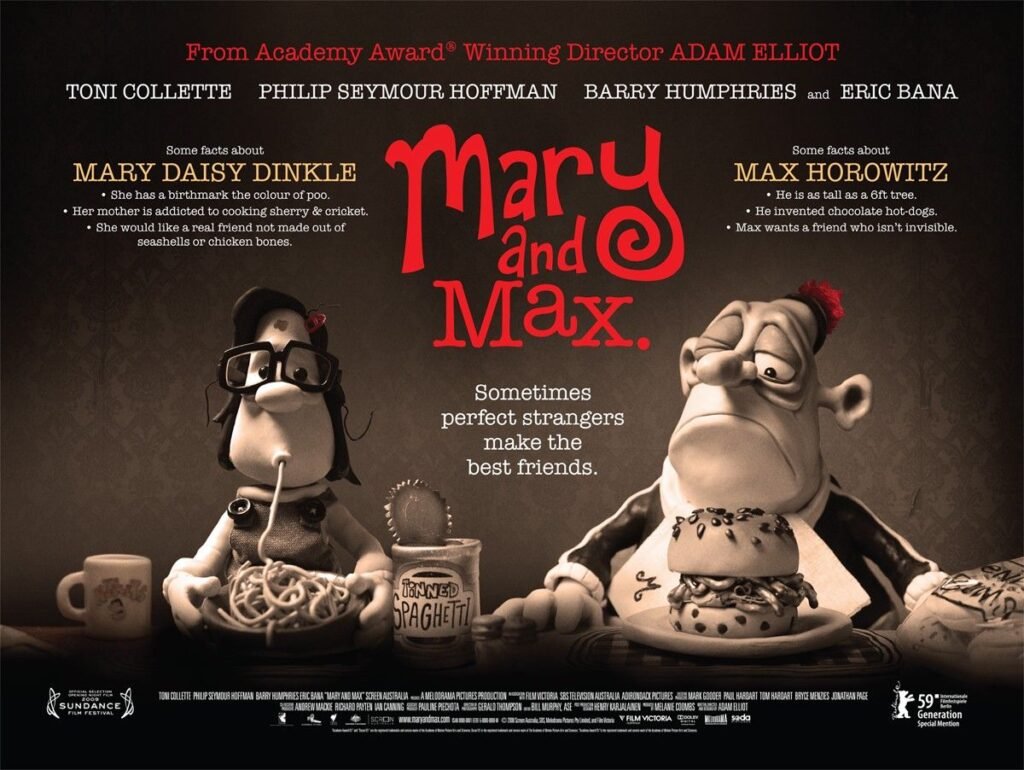
This claymation film, Mary and Max, gives no illusions as to what its target audience is. Using the painstaking skill of stop motion photography, combined with the incredibly difficult animation technique of claymation (the animated art of hand sculptured movement) Oscar winning creative genius Adam Elliot, (the writer, production designer and director of Mary and Max), leads us once again into his darkly humorous claymation world.
It is a production aimed squarely at a mature audience it delves into the broiling emotional issues of suicidality, depression, bullying, isolation, emotional abuse, alcoholism, death of parent, mental dysfunction and acute mental illness. As dreadful as that all sounds, the characters and situations deliver many amusing and endearing moments, peppered by a very dark wit.
The narrator of this tale is Barry Humphries, whose own comic genius imbues his articulate delivery with phlegmatic tongue, delightfully tinctured with sardonic and sarcastic undertones.
The combination of a deft script with Humphries’ skilful delivery, the brilliant and groundbreaking cinematography and marvellous handmade animation, elevates this small film to a masterpiece.
Under the superficial humour, lurks a brooding, deeper message that quietly reflects upon our social attitudes, our indifference, to the plight of others less fortunate.
We first find Mary, (introduced at the beginning of the film when she is 8 years old) living with her dysfunctional parents in Melbourne. The lonely child Mary, blighted by bad parenting and an obvious birthmark, is described in the opening lines of the film thusly,
“Mary Dinkle’s eyes have the colour of muddy puddles, her birthmark, the colour of pooh.” Mary’s world is coloured by hues of drab brown. We then see Mary observe two small dogs, one mounting the other. She thinks they are playing piggy back.
Mary is naïve, bordering on the dull witted. However, this will change.
While at the post office, Mary looks at interesting names in the New York telephone book and tries to imagine what they looked like. It is then she decides, in a quixotic moment, to write to Max Horowitz. Max is a lonely, obese, bored and isolated New Yorker man suffering Asperger’s Syndrome. His world is drab too, all the hues of grey. Initially, his mental condition made it difficult for him to respond to Mary, but once he made that first step, their friendship began to blossom, in an oddball fashion.
Both Mary and Max have their own quirky way of communicating and an even more awkward way of expressing affection. We see their separate lives develop and then watch as unintended offence, by one to the other, kills their friendship. Eventually, after much life experience, forgiveness is attained, and the appreciation for each other’s friendship is properly expressed.
Eight year old Mary is given voice by Bethany Whitmore, who genuinely sounds eight years old, because that was her actual age during production. Mary’s adult voice is by Toni Collette, Max Jerry Horowitz is voiced by Phillip Seymour Hoffman and Mary’s one young friend, her neighbour Damian Papadopoulos, is voiced by Eric Bana. All the V.O.s (voice overs) are in perfect harmony with their character and situation there are very well known stars behind some of these voices, yet their professionalism keeps you from identifying the actor behind the voice.
Although it is animation, this is not an escapist film, it bites and it makes you think. The seemingly innocuous format of claymation beguiles your mind into considering the plight of the people who are rarely considered that of the lonely and of the mentally disabled and you leave this film liking them, just as they are, faults and all. Max states, in his last letter to Mary, “I forgive you because you are imperfect. All humans are imperfect.”
I loved the rough hewing of the figures and their environment. It helped to further imbue this production as a true work of art, one that leaps from the screen and informs, embraces and entertains you.
The toned down hues, the greys of New York and the browns of Melbourne, served to differentiate between the natures of the characters, as much as being a statement about their respective localities. The use of ‘spot red’, (which is to highlight one particular thing in red, midst an otherwise dull tonal environment), creator Adam Elliot said was drawn from Spielberg’s use of the technique in Schindler’s List. It is an intriguing and effective technique.
For more movies like Mary and Max (2009) visit Hurawatch.
Also watch: