
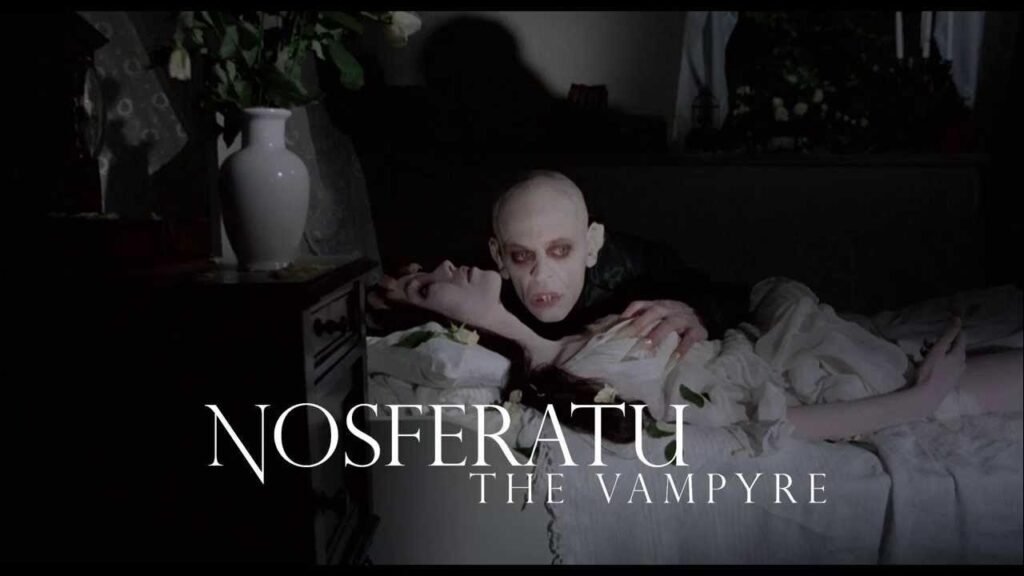
In 1979, Werner Herzog remade the 1922 silent German film “Nosferatu”, bringing the movie into full colour and sound, but keeping much of the atmosphere and look of F.W. Murnau’s classic.
Herzog considered the original “Nosferatu” to be the most important German film, and, on the receiving end of a large budget, wanted to make his tribute to Murnau. As Kinoeye notes, the story of the production is, as always with Herzog, almost more interesting than the film
Klaus Kinski, notable madman and famed actor, would play the vampire, having to endure 4 hours of makeup to look like Murnau’s monster, with white, ghastly skin, a bald head with prominent ears, and sharp fangs.
It’s interesting to note that, in our more accepted view of the vampire, the fangs are almost always extended canines, like the fangs of a wolf, or tiger, very much like a predator at the top of the chain. Such is our vision of the vampire an immortal being, frozen in ceramic beauty, preying on lesser beings. Our vampires are something to be feared and awed.
Herzog’s vampire is a different depiction Kinski’s fangs are long and sharp incisors, the teeth of a rodent, and, indeed, his slave, Renfield, calls him the ‘Lord of the Rats’. As the vampire arrives by boat, an army of rats descends on the town, bringing with them the plague.
The distinction is startling: Kinski plays Dracula as a rat, odious and disgusting. He feeds on people, spreading disease and fear, but, at the same time, he so desperately wants to be a part of the human race. He is, ultimately, a wretched and despicable character instead of fear, we feel dread at his presence, initially. Looking at Kinski’s hopeless, tragic eyes, we feel pity.
“Nosferatu the Vampyre” is a mesmerizing film, complex and soothing. Shot in Germany, Holland and Transylvania, Herzog’s eye for natural beauty almost threatens to eclipse the atmosphere in the film; the shots of the valley in Transylvania is, perhaps, the best tourist advertisement for the region. Beauty is forgotten, though, as Herzog shows us death and decay, reminding the viewer of the natural order: we may build the cities, but it’s the rats that will survive.
I say
Spectacular on all count. The movie is criticized for lacking the ability to scare audiences, but I think it’s an interesting and bold decision.
See it for
Isabelle Adjiani plays Jonathan Harker’s wife, Lucy Harker, and she’s both ravishing and strong-willed in this film, taking on the vampire menace head-on.
For more movies like Nosferatu the Vampyre (1979) visit Hurawatch.
Also watch: