
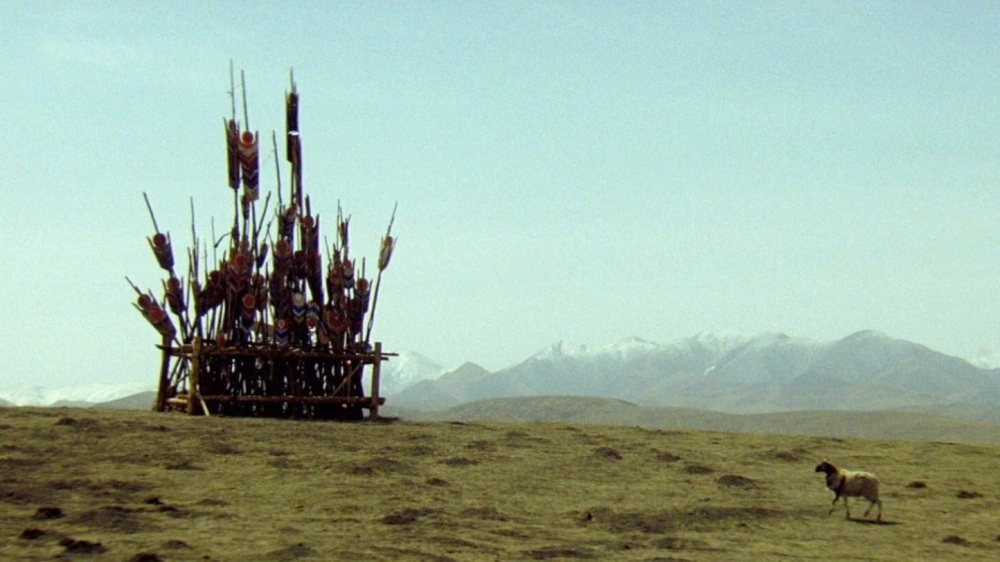

Tian Zhuangzhuang’s 1986 film, “Horse Thief”, passes its 88-minute runtime with hardly any dialogue, except for a few grunts and statements. It opens on the rocky terrain of Tibet, winds whipping fiercely over the mountains, as a Tibetan man, Norbu, steals a few horses from one of the local families.
While the narrative moves slowly, like grasses bending in a slight and randomly shifting breeze, Tian Zhuangzhuang’s film is a testament to realism he captures many of the local Tibetan rituals and prayers, capturing the brilliant colours of red and gold, which stand out like beacons on the Tibetan hills.
I’ve seen documentaries on Tibet, but they’ve all been lightweight, choosing to highlight the political issues and capturing images that do not challenge the viewer. “Horse Thief” departs from that logic, giving us an unrestricted, yet poetic view into the infamous ‘sky burial’, where the dead are left out to be ravaged and torn to shreds by vultures.
The shots of Tibet in summer are blissfully hedonistic, with wide open green hills, running river brooks and picture perfect blue skies. Norbu robs a caravan of pilgrims, however, carrying gifts for the temple, and is banished by his clan into exile, forcing him and his family to live by themselves when winter comes.
Winter in Tibet is a harsh, as you would imagine, but made worse with Tian Zhuangzhuang’s vision of montage, combining the haunting chants of the monks with the images of a traditional play, complete with skull masks and demonic bull heads. This is the stuff of nightmares, and it forces the viewer to recoil.
Ultimately, though, “Horse Thief” is an exhausting viewing, with the relatively short running time made to feel like an eternity, penance for our sins. To atone for his thieving ways, Norbu and his wife make a pilgrimage to the temple, walking one step, then laying down, face first, in the ground, then getting up to take the next step.
It must be exhausting to devote yourself like that, but the exhaustion and agony on the Tibetans faces was echoed by the audience, who grew restless at the seemingly disconnected film. “Horse Thief” is a powerful movie, banned when it came out, but not a film that I’d recommend to watch or watch again.
I say:
I’ve never seen any depiction of Tibetan culture as vivid as this film, but, unfortunately, as a film, it lacks direction and purpose. Much of the meaning is hidden in Buddhist culture, which removed much of the audience.
See it for:
The shots of the prayer wheels, spinning in the temple, appear to scream their chants silently.
To watch more movies like Horse Thief 1986 visit hurawatch
Also watch: